

Mastering French AES Phase 5 (DELTA-IE) in 2026
- Patrik Rajský

- Jan 13
- 3 min read
The definitive switchover to DELTA-IE on December 14, 2025, officially ended the era of the Single Administrative Document (SAD) in France. This transition marks France’s full alignment with the UCC Automated Export System (AES) Phase 5, replacing legacy EDIFACT systems with a rigid, XML-based ecosystem.

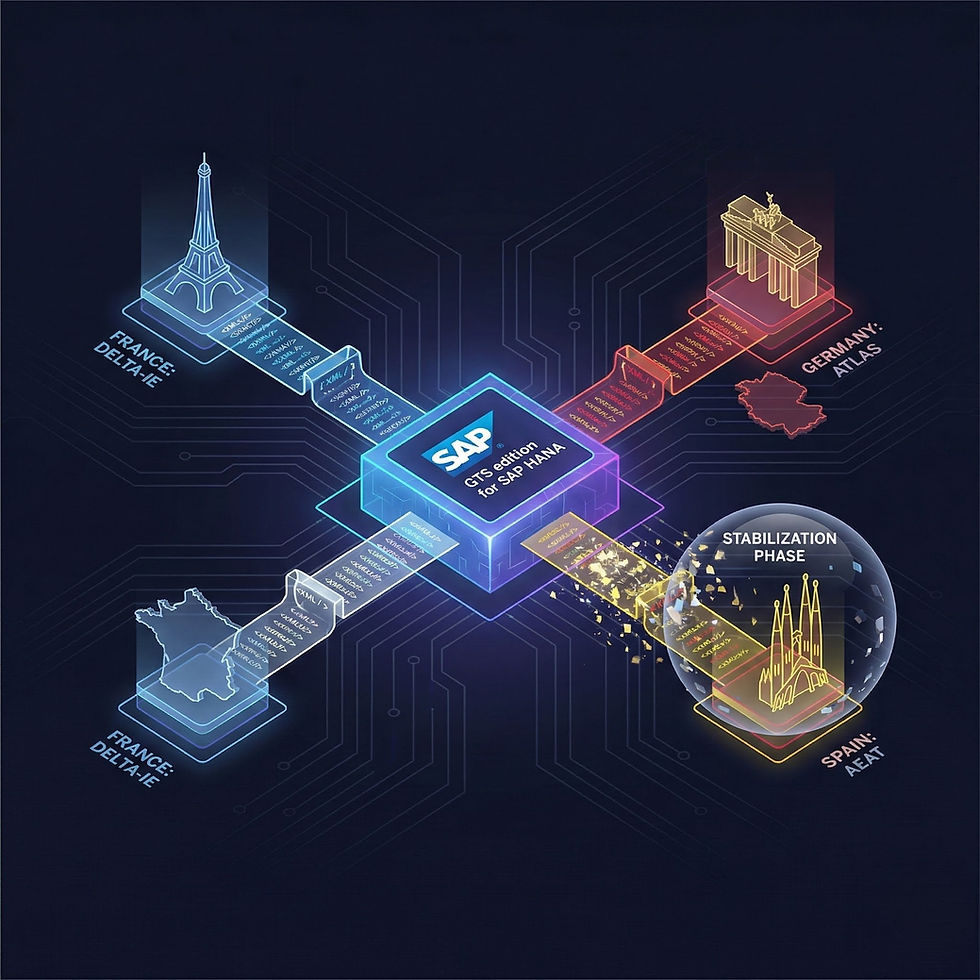
For SAP Leads, the start of 2026 is defined by a "stabilization phase" where national flows are operational, but interconnectivity issues—specifically regarding electronic proofs of exit (IE599)—persist. Failing to master these new data structures puts your VAT zero-rating compliance at significant risk.
The EUCDM Revolution: Data Elements Over "Boxes"
The transition to DELTA-IE is not just a format change; it is a fundamental re-engineering of business semantics rooted in the EU Customs Data Model (EUCDM).
Hierarchical Structure: The familiar "boxes" of the SAD (like Box 33) have been replaced by nested Data Elements (D.E.) in XML.
The SIREN Shift: Identification has moved from the 14-digit SIRET (location-based) to the 9-digit SIREN (legal entity-based) to align with UCC operator definitions.
Commodity Precision: Exports now strictly require 8-digit codes (Combined Nomenclature), while imports remain at 10 digits, requiring specific truncation logic in your GTS classification strategy.
Mandatory Logistics Integration: The ELO Barcode
The most disruptive change for physical logistics is the Enveloppe Logistique Obligatoire (ELO), the digital engine of the French "Smart Border".
The Mandate: As of 2026, using an ELO is strictly mandatory for accessing ferry operators and the Eurotunnel.
Grouping Mechanism: The ELO groups multiple Movement Reference Numbers (MRNs) under a single barcode, allowing customs agents to pair a truck's license plate with all underlying declarations instantly.
Empty Trucks: Even empty vehicles are now encouraged to use an ELO to access "Green Lane" return workflows, streamlining the return of logistics assets.
Technical SAP GTS Configuration Requirements
To maintain compliance in this environment, your system must support the generic AES Phase 5 framework provided by SAP.
Supported Platforms and Critical Notes
Organizations must be running SAP GTS 11.0 (with latest SPs) or GTS, edition for SAP HANA (E4H) 2020/2023. The foundational "Golden Note" is SAP Note 3552772, which delivers the shared infrastructure for the new French gateway connectivity.
Process Template (PPF) Updates
The message choreography has shifted to a strictly XML sequence within the legal regulation CUSFR:
IE515: The initial Export Declaration submission.
IE529: The "Mainlevée" (Release for Export) which triggers the EAD print.
IE599: The critical Exit Confirmation required for VAT evidence.
Strategic Roadmap for French AES 2026
While the "Big Bang" migration is finished, stabilizing these flows requires proactive IT leadership to manage the "messy reality" of early-stage adoption.
Automate the ELO Link: Manually typing MRNs into the ELO portal is unscalable and prone to error. We recommend developing a lightweight API to push MRNs directly from GTS to your carrier’s "Smart Border" tool.
Address the "Two-Step" Burden: The abolition of the D48 procedure means you must now use formal Simplified Declarations. Supplementary declarations must be filed by the 5th of the following month, drastically reducing your regularization window.
Leverage Document Intelligence: Just as you might use [SAP Document AI to automate supplier declarations], consider how automated data extraction can reconcile broker-submitted data against internal records to prevent DELTA-IE rejections.
Looking Ahead: The Pan-European Perspective
While France’s transition to DELTA-IE represents a major milestone for local operations, it is only one piece of a much larger puzzle. The move to AES Phase 5 is a continent-wide mandate that is reshaping how every EU member state interacts with SAP GTS.
Stay tuned for our next article, where we will zoom out from the French "Smart Border" to cover the EU-wide AES rollout. We will explore how to harmonize your global customs template to meet the diverse technical requirements of every European gateway.


Comments